What a Place Name Can Suggest, and What It Cannot Prove
Learn how to read a place name as a clue to language or landscape, and separate a plausible interpretation from claims the name cannot prove.
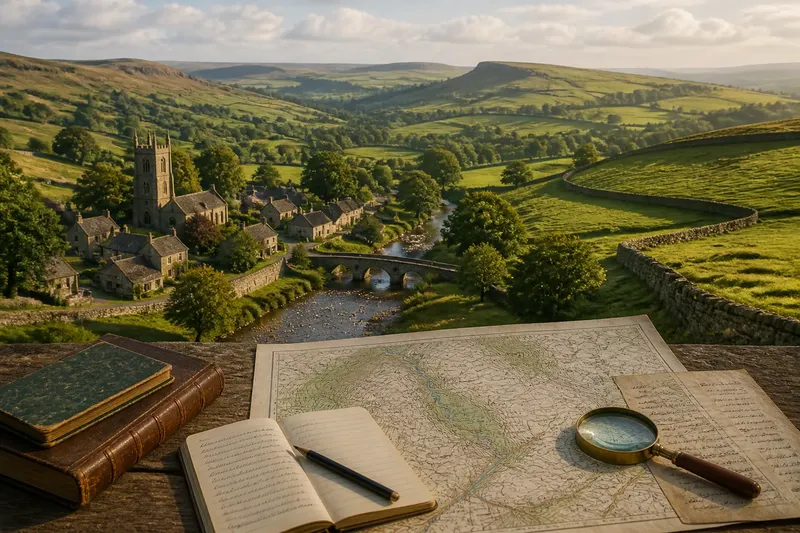
A place name can preserve a clue to an older language or a feature people once noticed, but the name alone cannot establish what happened there. Reading place names carefully means separating what their forms suggest from what other evidence would need to confirm. That distinction is especially useful in county geography, where familiar names can seem to explain a landscape before their origins are clear.
A name is evidence, but not a complete account
A place name is a word, or a group of words, used to identify a location. Its current spelling may preserve parts of an earlier form, but it is also the outcome of changes in speech, spelling and local usage. A map usually records a settled version of a name, not the full history of how people pronounced or understood it.
Names can be informative because communities often name places after visible features, uses, people or neighbouring settlements. A name that resembles an old word for a hill, wood or stream may point towards one of those associations. Yet resemblance is a starting point, not a verdict: similar sounds can arise from unrelated words, and a name may have changed as it passed between languages.
It helps to distinguish three levels of claim. The first is observable: a modern map spells the name in a particular way. The second is interpretative: a part of that spelling may correspond to a known word or naming element. The third is historical: the name records a particular community, event or feature at a particular time. Each level needs more support than the one before it.
Spelling can conceal the parts that matter
Many place names are compounds. One part may identify a feature, while another distinguishes it from nearby places or reflects a later addition. Over time, sounds can be shortened, joined or reshaped. A written form may also reflect the habits of a mapmaker or clerk rather than a direct record of an older pronunciation.
For that reason, it is risky to split a name into convenient modern words and assign each a meaning. A familiar ending might look like an English word but derive from a different linguistic element. Conversely, an unfamiliar form may have been altered until its older parts are hard to recognise. A proposed interpretation is stronger when it accounts for the whole name and fits known patterns in the relevant language.
Pronunciation can offer a useful additional clue, particularly where local speech differs from the spelling on a sign. It is not decisive by itself. Pronunciations vary between speakers, and a spoken form can change too. Treat spelling and pronunciation as records to compare, not as rival authorities from which one must automatically be chosen.
Landscape clues need a local fit
A name that appears to refer to a landform should be checked against the place it names. Look at the terrain on an Ordnance Survey map, then compare it with the view on the ground or with contour lines and mapped streams. A name may fit a small rise, hollow or former watercourse that is not obvious from a broad county map.
Even a good fit does not prove that the feature gave the place its name. A stream may have shifted, a wood may have disappeared, or a settlement may have adopted a name from a nearby feature rather than the ground beneath its houses. Some names also travel: a family, estate or neighbouring settlement can lend its name to another site.
Imagine you encounter a village name that seems to contain an old word for a ford. The map shows a stream nearby, but no crossing is marked. The sensible conclusion is that a water crossing is one possibility worth checking, not that a ford definitely stood at the village. Evidence of an older crossing, the name’s earlier written forms and its linguistic structure would each help assess the suggestion; without them, the interpretation remains tentative.
What can make an interpretation more convincing?
Useful checks come from sources that answer different questions. Early documents may show how a name was written at different times. A local place-name dictionary or county history may discuss its linguistic elements. Maps and physical geography can test whether a proposed feature makes sense. Parish records, estate papers or other local documents may provide context, though a mention of a place does not necessarily explain its name.
- Compare recorded forms: Look for older spellings in reliable local records. Decide whether they support the proposed sound changes or point elsewhere.
- Check the language: Consult a specialist place-name source for the relevant region. If the suggested element is not attested in a suitable language or period, keep the reading open.
- Inspect the setting: Use a detailed map to see whether the proposed hill, stream, woodland or crossing fits the named location. A feature several miles away may be less persuasive unless the name’s relationship to it is explained.
- Separate nearby names: Check whether a similar name belongs to a farm, parish, stream or estate rather than the settlement itself. The name may have transferred between places.
- Compare alternative readings: Ask whether another interpretation explains the spelling and setting at least as well. A reading that depends on one convenient resemblance should remain provisional.
These checks do not turn a name into a complete historical record. They help show whether an interpretation is linguistically plausible, geographically fitting and supported by documents, while keeping those forms of support distinct.
Which questions help keep a reading cautious?
Does a familiar word reveal the name’s origin?
Not on its own. Modern resemblance may be accidental, or the name may have changed enough that its parts no longer mean what they appear to mean today.
Can a place name identify the people who first lived there?
A name may preserve a language or naming tradition, but it cannot by itself identify the first inhabitants. Names can be adopted, translated or transferred as communities and land use change.
Does a landscape feature prove the proposed meaning?
A matching feature makes a reading more plausible, but it does not establish that the feature supplied the name. The feature may be later, the name may refer to another nearby place, or the resemblance may be coincidental.
What if local explanations disagree?
Record the competing interpretations and the evidence each uses. Prefer the one that best fits the older forms and relevant language, while acknowledging uncertainty if the evidence does not settle the question.
Use careful wording when sharing an interpretation
Small changes in phrasing can keep a useful clue from becoming an unsupported story. “The name may contain an element associated with woodland” signals a proposal. “The village was founded in a forest” makes a historical claim that would need separate evidence. Likewise, “the name could refer to a crossing” is more defensible than stating that a particular crossing existed.
Keep the name’s interpretation separate from broader claims about settlement, ownership or local identity. A place name can contribute to those questions, but it does not answer them alone. For a county walk or map note, give the name, the proposed meaning, the evidence checked and the main uncertainty. That makes the account more useful than an attractive but unqualified translation.
The most reliable way to read a place name is to treat it as a clue with a defined reach: it can invite a question about language or remembered landscape, then guide you towards records and terrain that may answer it. When describing what a place name suggests, say which part is visible, which part is inferred, and what remains unproved.